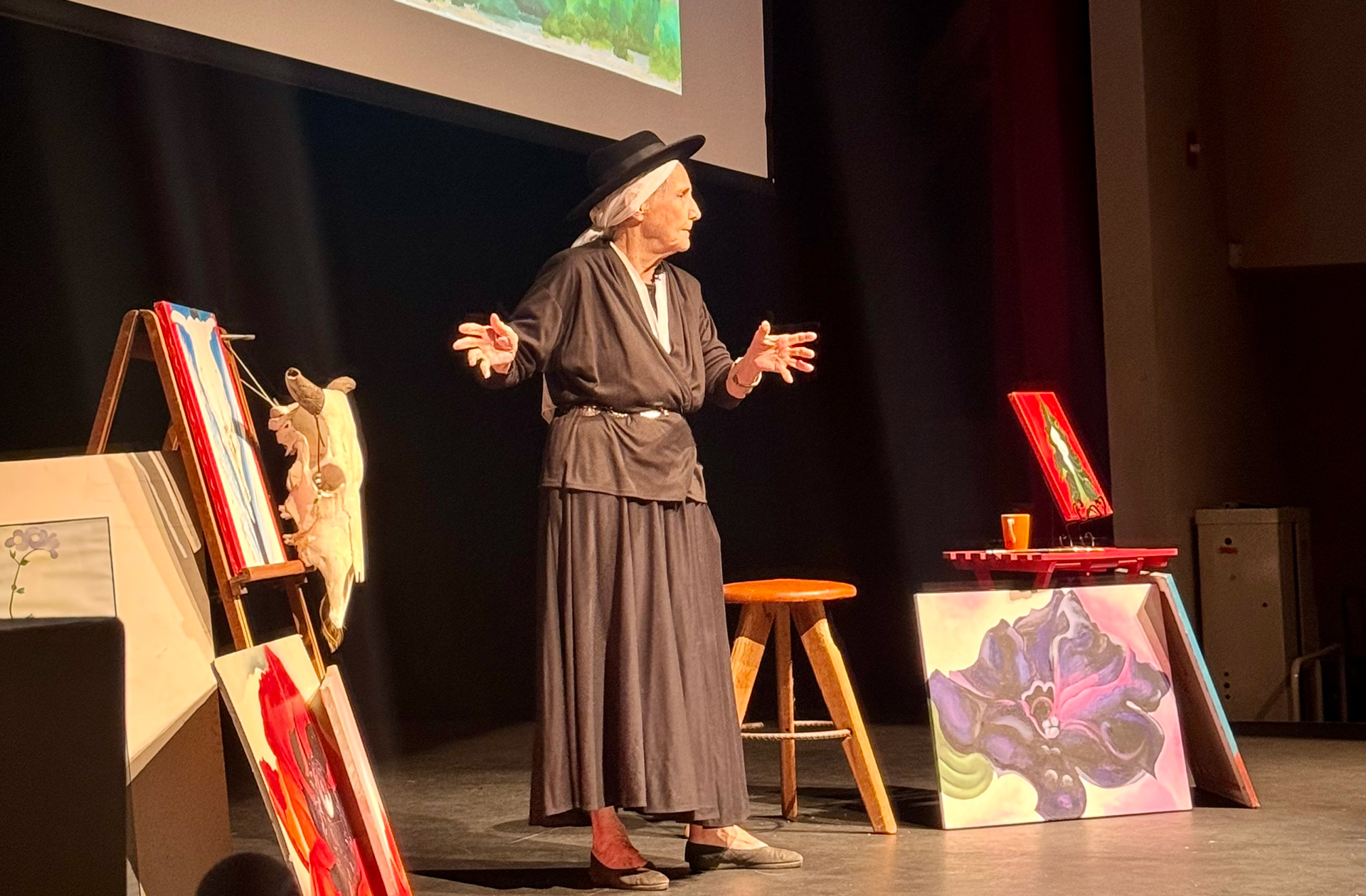
Georgia O’Keeffe didn’t simply paint what she saw – she revealed what the rest of us might have missed. Beneath her gaze, a flower became a universe, a weathered bone became poetry, and the vast desert sky seemed to breathe with color and light. Her gift was stripping away the noise and inviting us closer – to notice the curve, the shadow, the silence and the beauty hiding in plain sight.
Nan Colton does much the same with the artists she portrays. In her moving tribute to Georgia O’Keeffe, Nan took us beyond the familiar black hat, desert landscapes and flowers we thought we knew, revealing the fiercely independent woman who saw beauty differently and insisted upon experiencing the world on her own terms.
Through months of research, a journey into O’Keeffe’s beloved New Mexico and Nan’s extraordinary gifts as an actress, storyteller and teacher, history became intimate and alive. We stood beneath Georgia’s endless horizon, felt the pull of her “far away,” and experienced the remarkable spirit behind the paintings. It was one artist illuminating another, and for a while on September 27 at the Catherine A. Hickman Theater, it became remarkably easy to forget that the woman standing before us was Nan Colton at all.
The Woman Behind the Icon
Imitation, however, is never the point of a Nan Colton performance. She is less interested in reproducing a historical figure than discovering the human being beneath the familiar portrait. Who were they when no one was watching? What captivated or frightened them? And perhaps most importantly, what did they see that the rest of us did not?
Those questions seem especially appropriate for O’Keeffe, an artist whose legacy was built upon looking more closely. Nan approached her with much the same instinct, searching beyond the recognizable outlines to discover the subtle colors that made the woman extraordinary.
Looking for Georgia
Preparing a character can require five or six months of research before Nan begins distilling an entire human life into something capable of breathing onstage. But books could only take her so far with Georgia. Nan wanted to see what Georgia saw, to experience the landscapes that had shaped her imagination.
She traveled through Santa Fe and Ghost Ranch, eventually reaching O’Keeffe’s home at Abiquiú. The house was closed, but Nan noticed someone inside and knocked. That simple act of curiosity was rewarded with an unexpected private tour and something more intimate than access to a historic home: a glimpse into O’Keeffe’s beloved “far away.”
Standing amid that extraordinary landscape, Nan encountered a horizon that seemed infinite. She compared it to looking across an ocean whose edge continually retreats as you move toward it – except here, the ocean was made of land, stretching beneath an enormous New Mexico sky.
Something O’Keeffe had spent a lifetime expressing through paint suddenly became tangible. The colors, solitude and expansive silence were no longer simply elements of a painting. They were experiences Nan could feel for herself. The distinction between studying Georgia’s life and stepping inside her world began to blur.
Curiosity as an Art Form
Nan’s curiosity reaches far beyond documented facts. She searches for the spark beneath them – the private questions, contradictions and passions that transform remarkable people into who they became. Her approach combines the historian’s curiosity with an artist’s sensitivity to emotional details that conventional biographies often overlook.
Whether portraying Mary Cassatt, Virginia Woolf, Agatha Christie, Harriet Beecher Stowe, Miep Gies or Mary Shelley, Nan seems less interested in telling us what happened than allowing us to imagine what it felt like to be there. Mary Shelley becomes not simply the author of Frankenstein, but an astonishingly imaginative 18-year-old whose mind wandered into darkness and conjured one of literature’s most enduring creations.
That is where Nan’s artistry transcends impersonation. She closes the distance between biography and human experience, lifting extraordinary women from history and placing them before us – complex, curious, vulnerable and wonderfully alive. Rather than simply telling us who they were, she creates the remarkable feeling that we have met them.
And Then Georgia Left
With each question came another brushstroke: the brilliant sunlight and saturated colors of her South African childhood; the wildlife and storytelling that formed her imagination; and the young actress discovering that theater could do more than entertain – it could illuminate, educate and awaken curiosity. Then came broader strokes: Europe and Britain, a new life in America, a theater company, decades of performing and teaching, and 28 years associated with St. Petersburg’s Museum of Fine Arts.
Together, these experiences formed a canvas as textured and independent as the women Nan portrays. Perhaps that is why she understands them so intuitively. She has spent a lifetime studying the light and shadow in other people’s stories, discovering the subtle colors that make a human life extraordinary.
But this afternoon, the perspective shifted. The artist who had brought Georgia O’Keeffe into focus allowed us to see Nan Colton herself – a composition of curiosity, courage, independence and vulnerability. And among the most unexpected colors in that portrait was a deeply personal story about love.
A Different Kind of Love Story
After leaving South Africa and following the widening canvas of her life to America, Nan met an American man living aboard a boat in St. Petersburg. With the playful timing of a seasoned performer, she offered her assessment of one of America’s finest exports: “Your men.” She was smitten, and they married, sharing 13 happy years creating something beautiful from love’s unpredictable colors.
Then the palette changed. Her husband fell in love with another woman, and Nan confronted a chapter that could easily have been painted in darker tones – the reds of anger, grays of disappointment and shadows of betrayal. Instead, she reached for another color entirely: compassion.
She recognized that the life blazing within her – a life of theater, travel and creative ambition – was not necessarily the life her husband needed. He longed for a different composition, centered around home and family, and Nan believed another woman could give him something she could not. Rather than allowing disappointment to define their relationship, she made the extraordinary decision to let him go.
It wasn’t because the color had drained from her love, but because that love remained vivid enough to transcend possession. “When you love somebody,” Nan told us, “you give them what they need.” He found happiness, and remarkably, they remained best friends.
There was no bitterness in her telling, no attempt to paint herself as the wounded figure at the center of the canvas. Instead, Nan offered something infinitely more nuanced: the possibility that another person’s happiness can remain a color within your own, even when your lives no longer occupy the same frame.
For a moment, the theater became very quiet. Perhaps that story revealed something essential about Nan’s approach to both love and art. She doesn’t possess the women she portrays or impose her own colors upon their stories. She gives them room to be themselves, searching for their unique shades and contradictions before drawing upon her own emotional palette to help us experience theirs.
There is generosity in both kinds of love: the willingness to celebrate another person’s individuality without insisting it conform to our expectations.
The First Colors on the Palette
That respect for individuality was mixed into Nan’s palette long before she stepped onto a stage. When an audience question turned toward the independent women she portrays, Nan’s answer carried us back to South Africa and the woman who first taught her what independence meant: her mother.
Nan was one of seven daughters, raised by a woman determined that her girls possess something no circumstance could take away – the ability to think, learn and shape lives of their own. Her mother insisted upon education and independence. Six daughters would become professionals, reflecting a conviction more enduring than any inheritance: If you are a woman and you can think, you can be anything.
Suddenly, Nan’s own colors blended differently. We could see the young woman leaving South Africa, the actress discovering theater’s educational power, the woman crossing continents in pursuit of creative possibility, and the artist traveling thousands of miles simply to stand beneath Georgia O’Keeffe’s New Mexico sky before attempting to portray the woman who painted it.
The independence Nan admires in O’Keeffe was never something she needed to manufacture for the stage. She recognized it because she had been raised in its presence and lived its consequences. In many ways, she had painted her own life with the same colors – curiosity, courage, self-determination and an unwillingness to let convention define the boundaries of a woman’s imagination.
Two Artists, One Canvas
Perhaps that is why Georgia O’Keeffe and Nan Colton seemed to share the stage so naturally. Their artistic palettes differ, but their instincts are remarkably similar.
O’Keeffe worked in pigment, canvas, line, color and form, while Nan works in language, movement, expression, silence and light. Georgia could take a flower we might overlook and enlarge it until its curves and colors demanded attention. She could transform a sun-bleached desert bone into poetry or look across New Mexico’s vast emptiness and discover an entire spectrum of possibility.
Nan performs a similar transformation with human lives. She takes names so familiar that we may have stopped wondering about the people behind them and restores the colors history allowed to fade. Through her, Georgia becomes more than the black hat, flowers and desert. She becomes humor and stubbornness, solitude and passion, vulnerability and extraordinary resolve. Nan restores the shadows along with the sunlight because she understands that a portrait without contrast can never reveal its subject completely.
Therein lies the beautiful symbiosis between these two artists. Georgia teaches us to look more closely at the world, while Nan teaches us to look more closely at Georgia. One asks us to reconsider the flower, the bone and the horizon. The other asks us to reconsider the woman who saw them.
Both understand that looking is not the same as seeing, and that beauty often reveals itself only when we slow down enough to notice its subtleties. Both invite us beyond the familiar image to discover something extraordinary in what we thought we already knew.
On September 27, their palettes mingled on the stage of the Catherine A. Hickman Theater: Georgia’s colors illuminating Nan’s performance, and Nan’s richly lived colors illuminating Georgia in return.
One artist had spent a lifetime teaching us how to see. The other gave us the extraordinary opportunity to see her again.